
I. Portable Barcode Scanner: A Core Tool for Efficient Operations
In the fast-paced retail, logistics, warehousing and inventory management sectors, efficiency is critical to business success. The portable barcode scanner, with its flexibility and convenience, has become an indispensable tool across industries, revolutionizing the inefficient traditional manual data entry process.
Unlike fixed scanners tied to workstations, its core advantage lies inextreme mobility — staff can scan barcodes anytime, anywhere, from high warehouse shelves to delivery vans and crowded retail stores. Additionally, its lightweight design and fast decoding capability reduce frontline workload and manual errors, cutting costs and boosting operational efficiency.
Essentially, a portable barcode scanner is a compact handheld device that quickly reads and decodes barcode data (product, inventory, logistics info) and transmits it to computers, smartphones or tablets. It has become a core tool for improving daily efficiency, from small retail boutiques to large cross-border e-commerce logistics centers.
II. Multi-Scenario Adaptation: Application Advantages of Portable Barcode Scanners
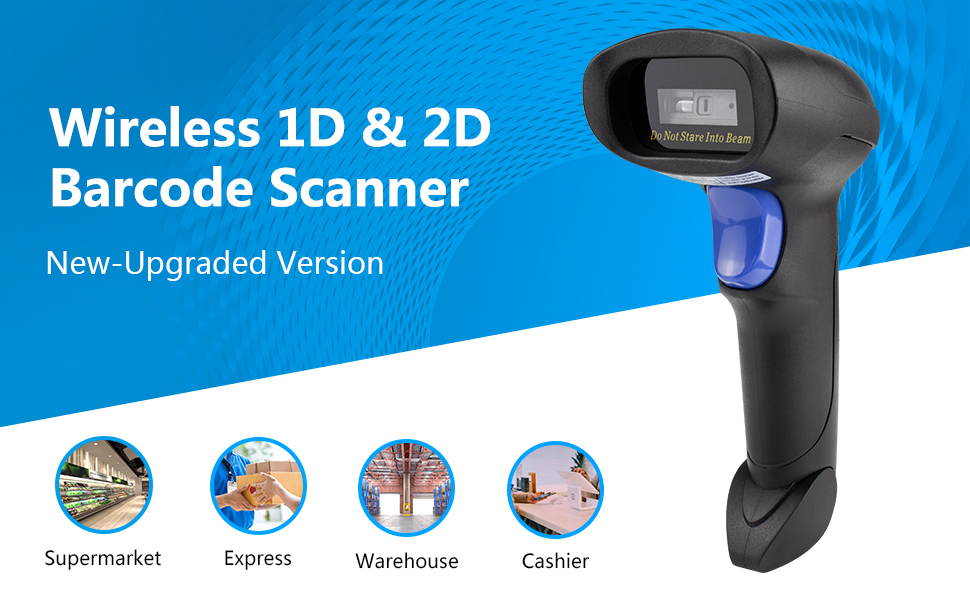
Portable barcode scanners are highly versatile, with their cross-scenario adaptability and efficiency widely demonstrated across industries:
In retail: Accelerates checkout, inventory checks and price verification, shortening customer queues and updating inventory in real time to avoid stockouts or overstock;
In logistics/warehousing: Key for package sorting, order picking and freight tracking, enabling full cargo traceability, reducing delays and enhancing supply chain visibility;
For field technicians: Tracks equipment and maintenance parts to ensure efficient repairs;
In healthcare: Manages patient records, drug labels and medical supplies, minimizing human errors in critical care.
III. Inventory of Common Types: Four Mainstream Portable Barcode Scanners and Their Advantages
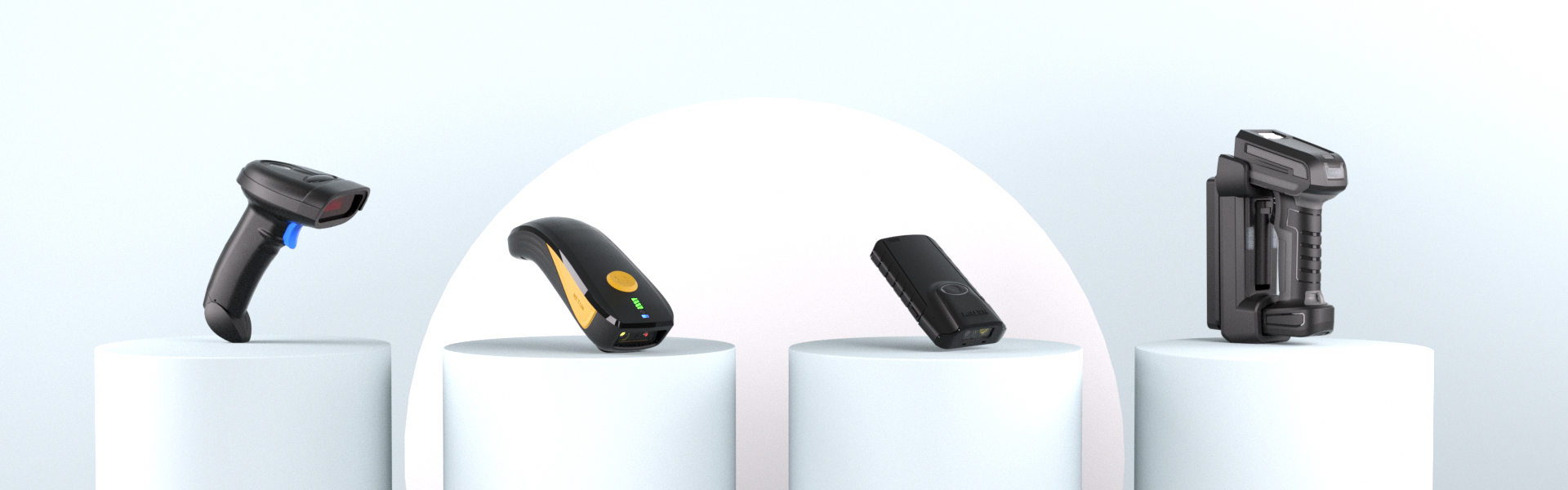
The market offers various portable barcode scanners for different needs. The four most common types are Handheld portable barcode scanner, Bluetooth portable barcode scanner, Wireless portable barcode scanner and Laser portable barcode scanner, each with unique advantages.
1. Handheld Portable Barcode Scanner
A classic, widely used type with core advantages of ease of use and quick setup. Ergonomically designed for one-hand use, it’s ideal for high-frequency, short-distance scanning (e.g., retail checkouts, small warehouse inventory), significantly improving frontline efficiency.
2. Bluetooth Portable Barcode Scanner
Features unrestrained mobility and smart device connectivity via Bluetooth, no cables or base stations needed. Perfect for field staff, delivery drivers and event workers, enabling mobile scanning over large areas and enhancing outdoor/on-the-go flexibility.
3. Wireless Portable Barcode Scanner
Outperforms Bluetooth models with longer transmission distance (via RF technology) and strong anti-interference. Equipped with a charging base (also a data receiver), it’s ideal for large warehouses or outdoor environments, ensuring stable, accurate data transmission even in high-interference areas.
4. Laser Portable Barcode Scanner
Boasts high precision and strong adaptability using laser beams for fast, accurate scanning. Reads 1D barcodes (some high-end models support 2D) and works even with damaged, stained or partially obscured barcodes. Ideal for warehouses and manufacturing workshops requiring high scanning efficiency and accuracy.
IV. Precision Selection Guide: How to Choose the Right Portable Barcode Scanner for Your Business?
Choosing the right portable barcode scanner hinges on accurately matching six key dimensions: scenario, barcode type, connection/battery life, durability, compatibility, and budget/after-sales service. Below is a concise, actionable selection process.
1. First Lock in the Core Usage Scenarios and Barcode Requirements (First Step of Selection)
Scenarios define equipment performance/protection requirements, while barcode types determine scanning engine selection — combining both narrows down options quickly.
Key selection criteria for scenarios and barcodes break down into four dimensions:
1. Scenario environment: Judge indoor/outdoor use, cleanliness, humidity/temperature, and drop risk. Choose commercial lightweight models for retail; industrial-grade (IP67+, 1.8m+ drop resistance) for warehousing/manufacturing; low-temperature resistant models for cold chains; and disinfectable casings for healthcare.
2. Barcode type: Clarify 1D/2D/mixed codes, density, and condition (reflective/damaged/small). Opt for Laser portable barcode scanner for high-frequency 1D scanning; image scanners for 2D/complex codes; and dedicated image engines for metal/reflective surfaces.
3. Scanning distance: Choose short-range (0-30cm) for checkouts; medium-range (0.5-2m) for shelf picking; and long-range industrial scanners for high shelves.
4. Operation mode: Select Bluetooth portable barcode scanner for field/mobile work;Wireless portable barcode scanner (RF for long distance) for large warehouses/outdoors; and handheld terminals with local storage for offline use.
2. Match Key Performance and Connection Methods (Fit the Enterprise's Existing Systems)
(1) Core Performance
Scanning speed/accuracy: Choose ≥300 decodes/sec for high-frequency tasks (e.g., sorting); high-resolution engines for medical/electronic high-precision needs. Battery life: Prioritize ≥8-hour battery, fast charging/hot-swappable batteries, and charging bases for multi-shift use. Ergonomics: Lightweight (<300g) with non-slip handles for long-term use.
Battery life and power supply: For wireless devices, priority should be given to those with battery life ≥ 8 hours and support fast charging/hot-swappable batteries; equipped with a charging base is more suitable for multi-shift operations.
Ergonomics: High-frequency handheld devices need to be lightweight (<300g) with non-slip handles to reduce fatigue during long-term operation.
(2) Connection and Compatibility
Connection: Wired USB for fixed workstations; Bluetooth portable barcode scanner for mobile use;Wireless portable barcode scanner (RF) for large-scale operations. Compatibility: Ensure support for Windows/Android/iOS and integration with ERP/WMS to avoid secondary development. Scalability: Reserve SDK/API for future RFID/4G/5G integration.
System adaptation: Confirm that it supports Windows/Android/iOS and can connect to existing management software such as ERP and WMS to avoid secondary development costs.
Scalability: Reserve SDK/API to support future connection of RFID, 4G/5G and other functions.
3. Evaluate Durability and Total Cost of Ownership (Avoid Hidden Expenses)
(1) Protection and Durability
Protection: IP67/IP68 for industrial use; special coatings for cold storage/oily environments. Durability: Prioritize MIL-STD-810G compliant models (1.8m+ drop resistance) for high-frequency use.
Durability: Refer to the MIL-STD-810G drop standard. For high-frequency operations, priority should be given to models that can withstand drops of more than 1.8m.
(2) Budget and After-Sales Service
Total Cost of Ownership (TCO): Include 3-5 year costs (battery replacement, maintenance, software). Choose brands with localized service, ≥1-year warranty, and 24/7 technical support; avoid low-cost, no-after-sales models.
Brand and after-sales service: Priority should be given to brands with localized services, warranty ≥ 1 year, and 24-hour technical response support; avoid low-cost models without after-sales service.
4. Industry-Specific Selection Quick Reference (Quick Matching)
Industry-specific recommendations:
Retail (pain points: fast checkout, accurate inventory): Handheld portable barcode scanner/Bluetooth model. Key specs: lightweight, 1D/2D compatible, plug-and-play.
Logistics/warehousing (pain points: long-distance scanning, durability, multi-gun collaboration): Wireless portable barcode scanner/industrial laser model. Key specs: IP67, long-distance depth of field, RF connection, offline storage.
Healthcare (pain points: hygiene, precision, disinfectability): Image-based Bluetooth scanner. Key specs: disinfectable casing, 2D compatible, low error rate.
Field/delivery (pain points: mobility, real-time upload):Bluetooth portable barcode scanner/handheld terminal. Key specs: long battery life, Bluetooth 5.0, 4G connectivity.
5. Procurement Decision-Making Process (Reduce Selection Risks)
1. List requirements: scenarios, barcode types, distance, connection, budget, compatible systems. 2. Trial 2-3 models in real environments for 2-4 weeks (test speed, battery life, compatibility). 3. Compare TCO (purchase + 3-year maintenance/upgrade costs) for highest ROI. 4. Pilot small-batch, then scale; finalize after-sales and spare parts agreements.
Sample trial: Lock 2-3 models and test them in real operating environments for 2-4 weeks to verify scanning speed, battery life, and compatibility.
Compare TCO: Calculate the purchase price + 3-year maintenance/consumables/upgrade costs, and select the plan with the highest ROI.
Bulk procurement: First conduct a small-batch pilot, confirm no problems before expanding capacity, and finalize after-sales service and spare parts agreements.
V. Summary: Choose the Right Equipment to Empower Enterprise Efficiency
In summary, a portable barcode scanner is not just a tool but an investment in efficiency and cost reduction, with core advantages of portability, multi-scenario adaptability and precision. The key to selection is aligning scenarios/barcode needs with scanning technology, connectivity, protection and compatibility, verified by TCO and trials. For example, use Handheld/Bluetooth portable barcode scanner for retail; Wireless portable barcode scanner + industrial laser for large warehouses; Bluetooth + long battery life for field work. Choosing the right device maximizes value and competitive edge.
The key to choosing the right equipment lies in first clarifying your own scenario and barcode needs, then matching scanning technology, connection methods, protection levels and system compatibility, and finally verifying the decision with total cost of ownership and sample trials. For example, choose a lightweight Handheld portable barcode scanner or Bluetooth portable barcode scanner for retail cash registers; choose a Wireless portable barcode scanner + industrial-grade laser engine for large warehouses; choose a Bluetooth portable barcode scanner + long battery life for field work. Only in this way can the equipment exert its maximum value and seize the opportunity in the fierce market competition.