
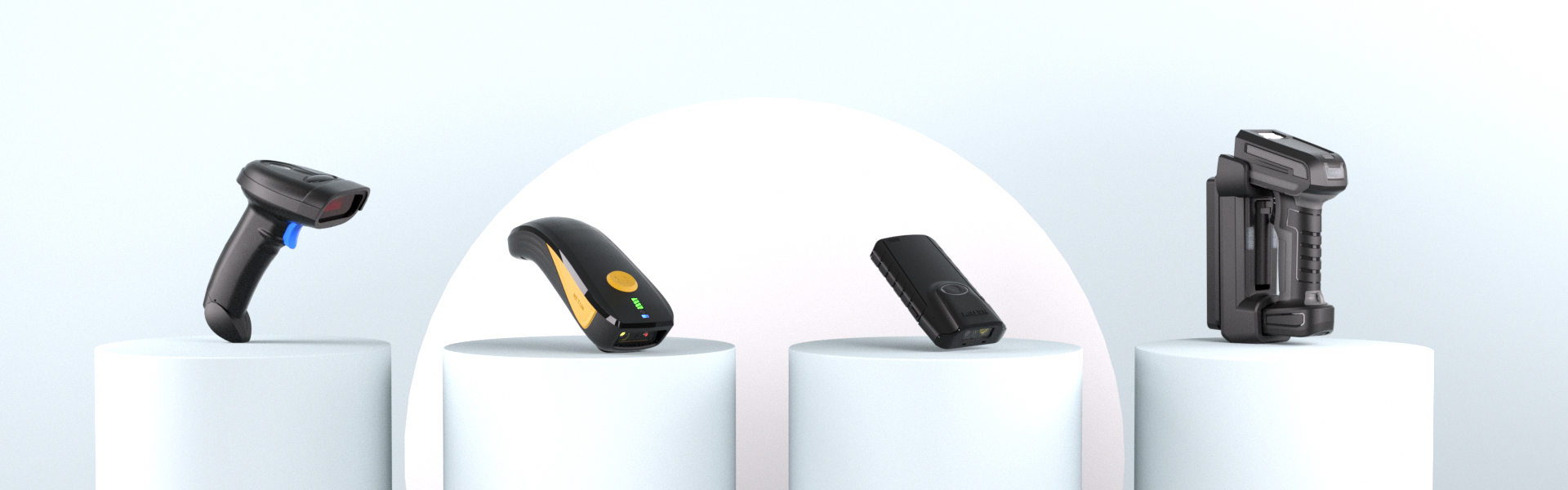
Modern logistics relies on real-time data capture and end-to-end traceability. As core data acquisition devices, logistics scanners connect warehouses, transportation, sorting, and delivery, greatly improving efficiency, reducing errors, and supporting intelligent supply chain operations.
Applications of Barcode Scanners in Logistics
Barcode scanners are widely used across the entire logistics chain, covering inbound, storage, sorting, outbound, delivery, and inventory.
Warehouse Inbound ManagementScan package barcodes to quickly record SKU, quantity, and batch information, auto-assign storage locations, and synchronize data to WMS systems. This replaces manual entry, boosts inbound speed, and ensures data accuracy.
Inventory & Storage ManagementReal-time inventory checks via scanning, locating goods, and updating stock levels. It supports FIFO, anti-dumping, and batch traceability, lowering inventory backlog and loss.
Sorting & Order PickingScan destination codes and order barcodes for automated or manual sorting, guiding goods to the right routes. It sharply reduces mis-sorting and missed shipments in high-throughput scenarios.
Outbound & Shipment VerificationScan and match order, goods, and waybill information before shipment to avoid wrong deliveries. Data is uploaded in real time for shipment tracking.
Last-Mile Delivery & Sign-offCouriers scan waybills and sign-off codes to update delivery status, supporting electronic signatures and package tracking, improving customer experience.
Return & Reverse LogisticsScan returned goods barcodes for quick inspection, classification, and warehousing, streamlining reverse logistics processes.
Working Principles of NETUM Logistics Barcode Scanners
NETUM mainly uses CMOS imaging recognition technology for stable and efficient decoding in logistics scenarios.
Lighting & ReflectionThe built-in LED light source illuminates the barcode; black bars absorb light and white spaces reflect light, creating a distinct light-intensity contrast.
Image AcquisitionThe high-sensitivity CMOS sensor captures reflected light to form a barcode image, supporting 1D/2D codes, screen codes, and damaged/fuzzy barcodes.
Photoelectric Conversion & Digital ProcessingOptical signals convert to analog electrical signals, then to digital signals via ADC. The dedicated decoding chip parses barcode content per coding rules.
Data TransmissionDecoded data is sent to terminals via USB, 2.4G wireless, or Bluetooth, connecting to ERP, WMS, and express systems.
Smart Adaptive FeaturesNETUM scanners support auto-sensing, omnidirectional scanning, and anti-shake design, adapting to high-speed sorting, handheld mobile, and fixed-platform scenarios.
How the Logistics Industry Chooses NETUM Barcode Scanners
Select based on scenario, code type, connectivity, durability, and system compatibility to balance efficiency and cost.
1. Match Scanning Scenarios
· Handheld mobile (warehouse, delivery): Choose wireless Bluetooth/2.4G models with long battery life and anti-drop performance.
· Fixed sorting/platform: Select omnidirectional hands-free desktop scanners for high-speed continuous scanning.
· Long-distance / high stacking: Pick models with wide scanning range and strong penetration.
·
2. Confirm Barcode Compatibility
· Express & e-commerce: Support Code 128, QR Code, Data Matrix, and screen barcodes.
· Harsh environments: Prioritize models that read damaged, dirty, reflective, or low-contrast barcodes.
3. Connectivity & System Compatibility
· Support USB, RS232, Bluetooth, 2.4G wireless for easy docking.
· Compatible with mainstream WMS, ERP, and express system software, plug-and-play.
4. Durability & Protection
· Logistics warehouses need IP54+ dust/water resistance and 1.5m+ drop resistance.
· Long runtime for high-intensity all-day use.
5. Decoding Speed & Efficiency
· High-speed sorting: ≥50 scans/sec.
· Daily warehouse: ≥30 scans/sec with auto-sensing and anti-duplicate scanning.
6. Budget & Configuration
· Small/medium warehouses: Cost-effective wired 2D models.
· Large logistics centers: Industrial-grade wireless or fixed omnidirectional scanners.
Conclusion
Logistics scanners are indispensable infrastructure in modern logistics systems. NETUM barcode scanners, with stable imaging technology, scenario-specific design, and strong compatibility, help logistics enterprises streamline operations, reduce errors, and enhance traceability. Choosing the right model based on actual scenarios maximizes productivity and cuts operational costs.